Mobile phone today is not solely a communication medium, but rather become smarter in handling multi-tasking activities than just talk to your friends. Not only time scheduler, notes and push mail but now people getting more advance in making their computer applications go to mobile. As the need to connected always has been greatly become important (to link to facebook, myspace…), WIFI is among the best options they have to fulfilled such need.
However, the biggest problem is on cell phone battery life. Even a simple changes to the software running on Wi-Fi access points could significantly extend or even double cell phone battery life. That’s the finding of a study that investigated why using Wi-Fi on a cell phone, and on some other portable devices, sucks up power so quickly. It found that a protocol designed to reduce Wi-Fi power drain often doesn’t work effectively.
Recently, Nokia says it’s developing technology that could draw enough power from ambient radio waves to keep a cell-phone handset topped up
Ambient electromagnetic radiation–emitted from Wi-Fi transmitters, cell-phone antennas, TV masts, and other sources–could be converted into enough electrical current to keep a battery topped up, says Markku Rouvala, a researcher from the Nokia Research Centre, in Cambridge, U.K. Rouvala says that his group is working towards a prototype that could harvest up to 50 milliwatts of power–enough to slowly recharge a phone that is switched off. He says current prototypes can harvest 3 to 5 milliwatts.
The Nokia device will work on the same principles as a crystal radio set or radio frequency identification (RFID) tag: by converting electromagnetic waves into an electrical signal. This requires two passive circuits. “Even if you are only getting microwatts, you can still harvest energy, provided your circuit is not using more power than it’s receiving,” Rouvala says.
To increase the amount of power that can be harvested and the range at which it works, Nokia is focusing on harvesting many different frequencies. “It needs a wideband receiver,” says Rouvala, to capture signals from between 500 megahertz and 10 gigahertz–a range that encompasses many different radio communication signals. Historically, energy-harvesting technologies have only been found in niche markets, powering wireless sensors and RFID tags in particular. If Nokia’s claims stand up, then it could push energy harvesting into mainstream consumer devices.
Wow….this would be a great achievement if the ‘power through wireless’ can be done. But what happen when the guy is using his VOIP service while charging his mobile ‘on air’. Will it drain his brain? will the electromagnetic conversion endanger human brain?
Showing posts with label VoIP. Show all posts
Showing posts with label VoIP. Show all posts
Sunday, 1 August 2010

From drain to gain
Mobile phone today is not solely a communication medium, but rather become smarter in handling multi-tasking activities than just talk to your friends. Not only time scheduler, notes and push mail but now people getting more advance in making their computer applications go to mobile. As the need to connected always has been greatly become important (to link to facebook, myspace…), WIFI is among the best options they have to fulfilled such need.
However, the biggest problem is on cell phone battery life. Even a simple changes to the software running on Wi-Fi access points could significantly extend or even double cell phone battery life. That’s the finding of a study that investigated why using Wi-Fi on a cell phone, and on some other portable devices, sucks up power so quickly. It found that a protocol designed to reduce Wi-Fi power drain often doesn’t work effectively.
Recently, Nokia says it’s developing technology that could draw enough power from ambient radio waves to keep a cell-phone handset topped up
Ambient electromagnetic radiation–emitted from Wi-Fi transmitters, cell-phone antennas, TV masts, and other sources–could be converted into enough electrical current to keep a battery topped up, says Markku Rouvala, a researcher from the Nokia Research Centre, in Cambridge, U.K. Rouvala says that his group is working towards a prototype that could harvest up to 50 milliwatts of power–enough to slowly recharge a phone that is switched off. He says current prototypes can harvest 3 to 5 milliwatts.
The Nokia device will work on the same principles as a crystal radio set or radio frequency identification (RFID) tag: by converting electromagnetic waves into an electrical signal. This requires two passive circuits. “Even if you are only getting microwatts, you can still harvest energy, provided your circuit is not using more power than it’s receiving,” Rouvala says.
To increase the amount of power that can be harvested and the range at which it works, Nokia is focusing on harvesting many different frequencies. “It needs a wideband receiver,” says Rouvala, to capture signals from between 500 megahertz and 10 gigahertz–a range that encompasses many different radio communication signals. Historically, energy-harvesting technologies have only been found in niche markets, powering wireless sensors and RFID tags in particular. If Nokia’s claims stand up, then it could push energy harvesting into mainstream consumer devices.
Wow….this would be a great achievement if the ‘power through wireless’ can be done. But what happen when the guy is using his VOIP service while charging his mobile ‘on air’. Will it drain his brain? will the electromagnetic conversion endanger human brain?
However, the biggest problem is on cell phone battery life. Even a simple changes to the software running on Wi-Fi access points could significantly extend or even double cell phone battery life. That’s the finding of a study that investigated why using Wi-Fi on a cell phone, and on some other portable devices, sucks up power so quickly. It found that a protocol designed to reduce Wi-Fi power drain often doesn’t work effectively.
Recently, Nokia says it’s developing technology that could draw enough power from ambient radio waves to keep a cell-phone handset topped up
Ambient electromagnetic radiation–emitted from Wi-Fi transmitters, cell-phone antennas, TV masts, and other sources–could be converted into enough electrical current to keep a battery topped up, says Markku Rouvala, a researcher from the Nokia Research Centre, in Cambridge, U.K. Rouvala says that his group is working towards a prototype that could harvest up to 50 milliwatts of power–enough to slowly recharge a phone that is switched off. He says current prototypes can harvest 3 to 5 milliwatts.
The Nokia device will work on the same principles as a crystal radio set or radio frequency identification (RFID) tag: by converting electromagnetic waves into an electrical signal. This requires two passive circuits. “Even if you are only getting microwatts, you can still harvest energy, provided your circuit is not using more power than it’s receiving,” Rouvala says.
To increase the amount of power that can be harvested and the range at which it works, Nokia is focusing on harvesting many different frequencies. “It needs a wideband receiver,” says Rouvala, to capture signals from between 500 megahertz and 10 gigahertz–a range that encompasses many different radio communication signals. Historically, energy-harvesting technologies have only been found in niche markets, powering wireless sensors and RFID tags in particular. If Nokia’s claims stand up, then it could push energy harvesting into mainstream consumer devices.
Wow….this would be a great achievement if the ‘power through wireless’ can be done. But what happen when the guy is using his VOIP service while charging his mobile ‘on air’. Will it drain his brain? will the electromagnetic conversion endanger human brain?
From drain to gain
Mobile phone today is not solely a communication medium, but rather become smarter in handling multi-tasking activities than just talk to your friends. Not only time scheduler, notes and push mail but now people getting more advance in making their computer applications go to mobile. As the need to connected always has been greatly become important (to link to facebook, myspace…), WIFI is among the best options they have to fulfilled such need.
However, the biggest problem is on cell phone battery life. Even a simple changes to the software running on Wi-Fi access points could significantly extend or even double cell phone battery life. That’s the finding of a study that investigated why using Wi-Fi on a cell phone, and on some other portable devices, sucks up power so quickly. It found that a protocol designed to reduce Wi-Fi power drain often doesn’t work effectively.
Recently, Nokia says it’s developing technology that could draw enough power from ambient radio waves to keep a cell-phone handset topped up
Ambient electromagnetic radiation–emitted from Wi-Fi transmitters, cell-phone antennas, TV masts, and other sources–could be converted into enough electrical current to keep a battery topped up, says Markku Rouvala, a researcher from the Nokia Research Centre, in Cambridge, U.K. Rouvala says that his group is working towards a prototype that could harvest up to 50 milliwatts of power–enough to slowly recharge a phone that is switched off. He says current prototypes can harvest 3 to 5 milliwatts.
The Nokia device will work on the same principles as a crystal radio set or radio frequency identification (RFID) tag: by converting electromagnetic waves into an electrical signal. This requires two passive circuits. “Even if you are only getting microwatts, you can still harvest energy, provided your circuit is not using more power than it’s receiving,” Rouvala says.
To increase the amount of power that can be harvested and the range at which it works, Nokia is focusing on harvesting many different frequencies. “It needs a wideband receiver,” says Rouvala, to capture signals from between 500 megahertz and 10 gigahertz–a range that encompasses many different radio communication signals. Historically, energy-harvesting technologies have only been found in niche markets, powering wireless sensors and RFID tags in particular. If Nokia’s claims stand up, then it could push energy harvesting into mainstream consumer devices.
Wow….this would be a great achievement if the ‘power through wireless’ can be done. But what happen when the guy is using his VOIP service while charging his mobile ‘on air’. Will it drain his brain? will the electromagnetic conversion endanger human brain?
However, the biggest problem is on cell phone battery life. Even a simple changes to the software running on Wi-Fi access points could significantly extend or even double cell phone battery life. That’s the finding of a study that investigated why using Wi-Fi on a cell phone, and on some other portable devices, sucks up power so quickly. It found that a protocol designed to reduce Wi-Fi power drain often doesn’t work effectively.
Recently, Nokia says it’s developing technology that could draw enough power from ambient radio waves to keep a cell-phone handset topped up
Ambient electromagnetic radiation–emitted from Wi-Fi transmitters, cell-phone antennas, TV masts, and other sources–could be converted into enough electrical current to keep a battery topped up, says Markku Rouvala, a researcher from the Nokia Research Centre, in Cambridge, U.K. Rouvala says that his group is working towards a prototype that could harvest up to 50 milliwatts of power–enough to slowly recharge a phone that is switched off. He says current prototypes can harvest 3 to 5 milliwatts.
The Nokia device will work on the same principles as a crystal radio set or radio frequency identification (RFID) tag: by converting electromagnetic waves into an electrical signal. This requires two passive circuits. “Even if you are only getting microwatts, you can still harvest energy, provided your circuit is not using more power than it’s receiving,” Rouvala says.
To increase the amount of power that can be harvested and the range at which it works, Nokia is focusing on harvesting many different frequencies. “It needs a wideband receiver,” says Rouvala, to capture signals from between 500 megahertz and 10 gigahertz–a range that encompasses many different radio communication signals. Historically, energy-harvesting technologies have only been found in niche markets, powering wireless sensors and RFID tags in particular. If Nokia’s claims stand up, then it could push energy harvesting into mainstream consumer devices.
Wow….this would be a great achievement if the ‘power through wireless’ can be done. But what happen when the guy is using his VOIP service while charging his mobile ‘on air’. Will it drain his brain? will the electromagnetic conversion endanger human brain?
Thursday, 12 February 2009
VoIP Next-Generation Network Overview
As far as I’m concerned, many modern telco engineers agree that VoIP can be deployed in many different network segments. To date, it has been progressively deployed in the backbone and enterprise networks. Deploying VoIP as an end-to-end Next-Generation Network solution introduces additional constraints and issues discussed by many VoIP researcher.

example of VoIP Next Generation Network architecture
Whatever the justifications brainstormed by many researcher, it come to conclusion that most service providers recognize the VoIP is the direction of the future. However when looking at a future PSTN scale solution service providers must ensure that the following key requirements are met to provide equivalence with the PSTN:
· Security
· Quality of Service
· Reliability
· Migration path
· OSS support
· Billing
· Network Interconnection
These issues are by no means simple and in many cases have delayed roll out of VoIP services. Future research in this field will look into more detail issues to consider at a high level how this next-generation network might be addressed. Perhaps, it can tackled as many issues as concerned by the researchers.
VoIP Next-Generation Network Overview
As far as I’m concerned, many modern telco engineers agree that VoIP can be deployed in many different network segments. To date, it has been progressively deployed in the backbone and enterprise networks. Deploying VoIP as an end-to-end Next-Generation Network solution introduces additional constraints and issues discussed by many VoIP researcher.
example of VoIP Next Generation Network architecture
Whatever the justifications brainstormed by many researcher, it come to conclusion that most service providers recognize the VoIP is the direction of the future. However when looking at a future PSTN scale solution service providers must ensure that the following key requirements are met to provide equivalence with the PSTN:
· Security
· Quality of Service
· Reliability
· Migration path
· OSS support
· Billing
· Network Interconnection
These issues are by no means simple and in many cases have delayed roll out of VoIP services. Future research in this field will look into more detail issues to consider at a high level how this next-generation network might be addressed. Perhaps, it can tackled as many issues as concerned by the researchers.
VoIP Next-Generation Network Overview
As far as I’m concerned, many modern telco engineers agree that VoIP can be deployed in many different network segments. To date, it has been progressively deployed in the backbone and enterprise networks. Deploying VoIP as an end-to-end Next-Generation Network solution introduces additional constraints and issues discussed by many VoIP researcher.
example of VoIP Next Generation Network architecture
Whatever the justifications brainstormed by many researcher, it come to conclusion that most service providers recognize the VoIP is the direction of the future. However when looking at a future PSTN scale solution service providers must ensure that the following key requirements are met to provide equivalence with the PSTN:
· Security
· Quality of Service
· Reliability
· Migration path
· OSS support
· Billing
· Network Interconnection
These issues are by no means simple and in many cases have delayed roll out of VoIP services. Future research in this field will look into more detail issues to consider at a high level how this next-generation network might be addressed. Perhaps, it can tackled as many issues as concerned by the researchers.
Sunday, 6 April 2008
WiMax vs WiFi
WiMax (802.16e) is a newer standard of wireless networking designed to provide the last mile of high speed internet access to the end user. Some people would call Wimax WiFi on steroids but this would be to broad of an assessment. Wifi was and still will be used in LAN environments for the foreseeable future. WiMax was designed to provide (MAN) Metropolitan Area Access, to homes and businesses.
WiMax base stations will have the ability to provide approximately 60 businesses with T1 access and hundreds of homes with DSL/Cable speed access…in theory. Engineers are stating that WiMax has the capability of reaching 30 Miles but real world testing has shown 4-8 mile working radius.
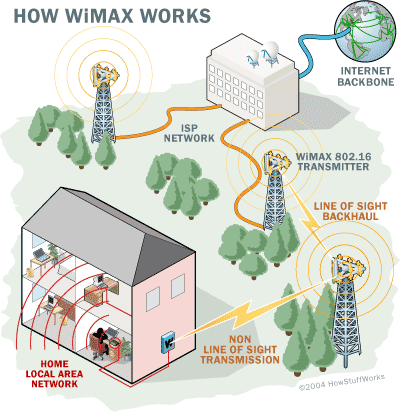
WiMax (MAN) deployments are similar to a WiFi network. First the ISP would have their T3 or higher access. The ISP would then use line of sight antennas (Bridges) to connect to towers that would distribute the non line of sight signal to (MAN) residential/business clients.
WiMax line of sight antennas operate at a higher Frequency up to 66mhz. Distribution antennas do not have to be in the line of sight with their clients. Non – line of sight towers operate on a range similar to WiFi . WiMax can operate right next to cell phone towers with no interference.
WiMax networks are similar to Wifi in deployment. The Wimax Base station/Tower will beam a signal to a WiMax Receiver. Similar to a WiFi access point sending a signal to a laptop. As far as I can tell laptops will be shipping with Wimax receivers in 2006.
QOS (Quality of Service) is an major issue with WiMax because of the number of people accessing a tower at once. Some would think that a tower could be easily overloaded with a lot of people accessing it at once. Built into the WiMax standard is an algorithm that when the tower/base station is nearing capacity then it automatically will transfer the user to another WiMax tower or cell. Unlike a Wifi clients who have to kind of fight to stay associated with a given access point; WiMax will only have to perform this hand shake at the MAC level the first time they access the network.
WiMax is designed for building a network infrastructure when the environment or distance is not favorable to a wired network. Also, WiMax is a cheaper and quicker alternative than having to lay wire. Third world countries will greatly benefit from deploying WiMax networks. WiMax can handle virtually all the same protocols Wifi can including VOIP. African countries are now going to start deploying WiMax networks instead of cell phone networks. Disaster zones can also utilize WiMax giving them the ability to distribute crisis information quickly and cheaply.
Militaries are already using wireless technology to connect remote sites. Logistics will be simplified with the ease of tracking with RF technologies. WiMax can also handle Webcams and streaming video which would give commanders eyes on target capability. Just imagine if planes were able to drop preconfigured self deploying WiMax antennas in strategic areas giving troops real time battlefield intel. Armed with wireless cameras, drones and a GPS one soldier would truly be an Army of One.
As WiMax is deployed in more areas theory and real life capabilities of WiMax will come to light. The differences between WiMax and Wifi are simple. Think of a WiMax network as an ISP with out wires, with the signal providing your internet access to your business/ home. Wifi will be used within in your LAN for the near future.
Eric Meyer writes about networking wireless technology. Visit his blog here.
WiMax base stations will have the ability to provide approximately 60 businesses with T1 access and hundreds of homes with DSL/Cable speed access…in theory. Engineers are stating that WiMax has the capability of reaching 30 Miles but real world testing has shown 4-8 mile working radius.
WiMax (MAN) deployments are similar to a WiFi network. First the ISP would have their T3 or higher access. The ISP would then use line of sight antennas (Bridges) to connect to towers that would distribute the non line of sight signal to (MAN) residential/business clients.
WiMax line of sight antennas operate at a higher Frequency up to 66mhz. Distribution antennas do not have to be in the line of sight with their clients. Non – line of sight towers operate on a range similar to WiFi . WiMax can operate right next to cell phone towers with no interference.
WiMax networks are similar to Wifi in deployment. The Wimax Base station/Tower will beam a signal to a WiMax Receiver. Similar to a WiFi access point sending a signal to a laptop. As far as I can tell laptops will be shipping with Wimax receivers in 2006.
QOS (Quality of Service) is an major issue with WiMax because of the number of people accessing a tower at once. Some would think that a tower could be easily overloaded with a lot of people accessing it at once. Built into the WiMax standard is an algorithm that when the tower/base station is nearing capacity then it automatically will transfer the user to another WiMax tower or cell. Unlike a Wifi clients who have to kind of fight to stay associated with a given access point; WiMax will only have to perform this hand shake at the MAC level the first time they access the network.
WiMax is designed for building a network infrastructure when the environment or distance is not favorable to a wired network. Also, WiMax is a cheaper and quicker alternative than having to lay wire. Third world countries will greatly benefit from deploying WiMax networks. WiMax can handle virtually all the same protocols Wifi can including VOIP. African countries are now going to start deploying WiMax networks instead of cell phone networks. Disaster zones can also utilize WiMax giving them the ability to distribute crisis information quickly and cheaply.
Militaries are already using wireless technology to connect remote sites. Logistics will be simplified with the ease of tracking with RF technologies. WiMax can also handle Webcams and streaming video which would give commanders eyes on target capability. Just imagine if planes were able to drop preconfigured self deploying WiMax antennas in strategic areas giving troops real time battlefield intel. Armed with wireless cameras, drones and a GPS one soldier would truly be an Army of One.
As WiMax is deployed in more areas theory and real life capabilities of WiMax will come to light. The differences between WiMax and Wifi are simple. Think of a WiMax network as an ISP with out wires, with the signal providing your internet access to your business/ home. Wifi will be used within in your LAN for the near future.
Eric Meyer writes about networking wireless technology. Visit his blog here.
WiMax vs WiFi
WiMax (802.16e) is a newer standard of wireless networking designed to provide the last mile of high speed internet access to the end user. Some people would call Wimax WiFi on steroids but this would be to broad of an assessment. Wifi was and still will be used in LAN environments for the foreseeable future. WiMax was designed to provide (MAN) Metropolitan Area Access, to homes and businesses.
WiMax base stations will have the ability to provide approximately 60 businesses with T1 access and hundreds of homes with DSL/Cable speed access…in theory. Engineers are stating that WiMax has the capability of reaching 30 Miles but real world testing has shown 4-8 mile working radius.
WiMax (MAN) deployments are similar to a WiFi network. First the ISP would have their T3 or higher access. The ISP would then use line of sight antennas (Bridges) to connect to towers that would distribute the non line of sight signal to (MAN) residential/business clients.
WiMax line of sight antennas operate at a higher Frequency up to 66mhz. Distribution antennas do not have to be in the line of sight with their clients. Non – line of sight towers operate on a range similar to WiFi . WiMax can operate right next to cell phone towers with no interference.
WiMax networks are similar to Wifi in deployment. The Wimax Base station/Tower will beam a signal to a WiMax Receiver. Similar to a WiFi access point sending a signal to a laptop. As far as I can tell laptops will be shipping with Wimax receivers in 2006.
QOS (Quality of Service) is an major issue with WiMax because of the number of people accessing a tower at once. Some would think that a tower could be easily overloaded with a lot of people accessing it at once. Built into the WiMax standard is an algorithm that when the tower/base station is nearing capacity then it automatically will transfer the user to another WiMax tower or cell. Unlike a Wifi clients who have to kind of fight to stay associated with a given access point; WiMax will only have to perform this hand shake at the MAC level the first time they access the network.
WiMax is designed for building a network infrastructure when the environment or distance is not favorable to a wired network. Also, WiMax is a cheaper and quicker alternative than having to lay wire. Third world countries will greatly benefit from deploying WiMax networks. WiMax can handle virtually all the same protocols Wifi can including VOIP. African countries are now going to start deploying WiMax networks instead of cell phone networks. Disaster zones can also utilize WiMax giving them the ability to distribute crisis information quickly and cheaply.
Militaries are already using wireless technology to connect remote sites. Logistics will be simplified with the ease of tracking with RF technologies. WiMax can also handle Webcams and streaming video which would give commanders eyes on target capability. Just imagine if planes were able to drop preconfigured self deploying WiMax antennas in strategic areas giving troops real time battlefield intel. Armed with wireless cameras, drones and a GPS one soldier would truly be an Army of One.
As WiMax is deployed in more areas theory and real life capabilities of WiMax will come to light. The differences between WiMax and Wifi are simple. Think of a WiMax network as an ISP with out wires, with the signal providing your internet access to your business/ home. Wifi will be used within in your LAN for the near future.
Eric Meyer writes about networking wireless technology. Visit his blog here.
WiMax base stations will have the ability to provide approximately 60 businesses with T1 access and hundreds of homes with DSL/Cable speed access…in theory. Engineers are stating that WiMax has the capability of reaching 30 Miles but real world testing has shown 4-8 mile working radius.
WiMax (MAN) deployments are similar to a WiFi network. First the ISP would have their T3 or higher access. The ISP would then use line of sight antennas (Bridges) to connect to towers that would distribute the non line of sight signal to (MAN) residential/business clients.
WiMax line of sight antennas operate at a higher Frequency up to 66mhz. Distribution antennas do not have to be in the line of sight with their clients. Non – line of sight towers operate on a range similar to WiFi . WiMax can operate right next to cell phone towers with no interference.
WiMax networks are similar to Wifi in deployment. The Wimax Base station/Tower will beam a signal to a WiMax Receiver. Similar to a WiFi access point sending a signal to a laptop. As far as I can tell laptops will be shipping with Wimax receivers in 2006.
QOS (Quality of Service) is an major issue with WiMax because of the number of people accessing a tower at once. Some would think that a tower could be easily overloaded with a lot of people accessing it at once. Built into the WiMax standard is an algorithm that when the tower/base station is nearing capacity then it automatically will transfer the user to another WiMax tower or cell. Unlike a Wifi clients who have to kind of fight to stay associated with a given access point; WiMax will only have to perform this hand shake at the MAC level the first time they access the network.
WiMax is designed for building a network infrastructure when the environment or distance is not favorable to a wired network. Also, WiMax is a cheaper and quicker alternative than having to lay wire. Third world countries will greatly benefit from deploying WiMax networks. WiMax can handle virtually all the same protocols Wifi can including VOIP. African countries are now going to start deploying WiMax networks instead of cell phone networks. Disaster zones can also utilize WiMax giving them the ability to distribute crisis information quickly and cheaply.
Militaries are already using wireless technology to connect remote sites. Logistics will be simplified with the ease of tracking with RF technologies. WiMax can also handle Webcams and streaming video which would give commanders eyes on target capability. Just imagine if planes were able to drop preconfigured self deploying WiMax antennas in strategic areas giving troops real time battlefield intel. Armed with wireless cameras, drones and a GPS one soldier would truly be an Army of One.
As WiMax is deployed in more areas theory and real life capabilities of WiMax will come to light. The differences between WiMax and Wifi are simple. Think of a WiMax network as an ISP with out wires, with the signal providing your internet access to your business/ home. Wifi will be used within in your LAN for the near future.
Eric Meyer writes about networking wireless technology. Visit his blog here.
WiMax vs WiFi
WiMax (802.16e) is a newer standard of wireless networking designed to provide the last mile of high speed internet access to the end user. Some people would call Wimax WiFi on steroids but this would be to broad of an assessment. Wifi was and still will be used in LAN environments for the foreseeable future. WiMax was designed to provide (MAN) Metropolitan Area Access, to homes and businesses.
WiMax base stations will have the ability to provide approximately 60 businesses with T1 access and hundreds of homes with DSL/Cable speed access…in theory. Engineers are stating that WiMax has the capability of reaching 30 Miles but real world testing has shown 4-8 mile working radius.
WiMax (MAN) deployments are similar to a WiFi network. First the ISP would have their T3 or higher access. The ISP would then use line of sight antennas (Bridges) to connect to towers that would distribute the non line of sight signal to (MAN) residential/business clients.
WiMax line of sight antennas operate at a higher Frequency up to 66mhz. Distribution antennas do not have to be in the line of sight with their clients. Non – line of sight towers operate on a range similar to WiFi . WiMax can operate right next to cell phone towers with no interference.
WiMax networks are similar to Wifi in deployment. The Wimax Base station/Tower will beam a signal to a WiMax Receiver. Similar to a WiFi access point sending a signal to a laptop. As far as I can tell laptops will be shipping with Wimax receivers in 2006.
QOS (Quality of Service) is an major issue with WiMax because of the number of people accessing a tower at once. Some would think that a tower could be easily overloaded with a lot of people accessing it at once. Built into the WiMax standard is an algorithm that when the tower/base station is nearing capacity then it automatically will transfer the user to another WiMax tower or cell. Unlike a Wifi clients who have to kind of fight to stay associated with a given access point; WiMax will only have to perform this hand shake at the MAC level the first time they access the network.
WiMax is designed for building a network infrastructure when the environment or distance is not favorable to a wired network. Also, WiMax is a cheaper and quicker alternative than having to lay wire. Third world countries will greatly benefit from deploying WiMax networks. WiMax can handle virtually all the same protocols Wifi can including VOIP. African countries are now going to start deploying WiMax networks instead of cell phone networks. Disaster zones can also utilize WiMax giving them the ability to distribute crisis information quickly and cheaply.
Militaries are already using wireless technology to connect remote sites. Logistics will be simplified with the ease of tracking with RF technologies. WiMax can also handle Webcams and streaming video which would give commanders eyes on target capability. Just imagine if planes were able to drop preconfigured self deploying WiMax antennas in strategic areas giving troops real time battlefield intel. Armed with wireless cameras, drones and a GPS one soldier would truly be an Army of One.
As WiMax is deployed in more areas theory and real life capabilities of WiMax will come to light. The differences between WiMax and Wifi are simple. Think of a WiMax network as an ISP with out wires, with the signal providing your internet access to your business/ home. Wifi will be used within in your LAN for the near future.
Eric Meyer writes about networking wireless technology. Visit his blog here.
WiMax base stations will have the ability to provide approximately 60 businesses with T1 access and hundreds of homes with DSL/Cable speed access…in theory. Engineers are stating that WiMax has the capability of reaching 30 Miles but real world testing has shown 4-8 mile working radius.
WiMax (MAN) deployments are similar to a WiFi network. First the ISP would have their T3 or higher access. The ISP would then use line of sight antennas (Bridges) to connect to towers that would distribute the non line of sight signal to (MAN) residential/business clients.
WiMax line of sight antennas operate at a higher Frequency up to 66mhz. Distribution antennas do not have to be in the line of sight with their clients. Non – line of sight towers operate on a range similar to WiFi . WiMax can operate right next to cell phone towers with no interference.
WiMax networks are similar to Wifi in deployment. The Wimax Base station/Tower will beam a signal to a WiMax Receiver. Similar to a WiFi access point sending a signal to a laptop. As far as I can tell laptops will be shipping with Wimax receivers in 2006.
QOS (Quality of Service) is an major issue with WiMax because of the number of people accessing a tower at once. Some would think that a tower could be easily overloaded with a lot of people accessing it at once. Built into the WiMax standard is an algorithm that when the tower/base station is nearing capacity then it automatically will transfer the user to another WiMax tower or cell. Unlike a Wifi clients who have to kind of fight to stay associated with a given access point; WiMax will only have to perform this hand shake at the MAC level the first time they access the network.
WiMax is designed for building a network infrastructure when the environment or distance is not favorable to a wired network. Also, WiMax is a cheaper and quicker alternative than having to lay wire. Third world countries will greatly benefit from deploying WiMax networks. WiMax can handle virtually all the same protocols Wifi can including VOIP. African countries are now going to start deploying WiMax networks instead of cell phone networks. Disaster zones can also utilize WiMax giving them the ability to distribute crisis information quickly and cheaply.
Militaries are already using wireless technology to connect remote sites. Logistics will be simplified with the ease of tracking with RF technologies. WiMax can also handle Webcams and streaming video which would give commanders eyes on target capability. Just imagine if planes were able to drop preconfigured self deploying WiMax antennas in strategic areas giving troops real time battlefield intel. Armed with wireless cameras, drones and a GPS one soldier would truly be an Army of One.
As WiMax is deployed in more areas theory and real life capabilities of WiMax will come to light. The differences between WiMax and Wifi are simple. Think of a WiMax network as an ISP with out wires, with the signal providing your internet access to your business/ home. Wifi will be used within in your LAN for the near future.
Eric Meyer writes about networking wireless technology. Visit his blog here.
Subscribe to:
Posts (Atom)