BRIEF REVIEW OF ADAPTATION AND PROTECTION STRATEGIES AT DIFFERENT LAYERS
Numerous solutions have been proposed for efficient multimedia streaming over wireless networks. Potential solutions for robust wireless multimedia transmission over error-prone networks include application-layer packetization, (rate-distortion optimized) scheduling, joint source-channel coding, error resilience, and error concealment mechanisms. An excellent review of channel-adaptive multimedia streaming research is provided in.
Transport issues for wireless (multimedia) transmission have been examined in. At the PHY and MAC layers, significant gains have been reported by adopting cross-layer optimization, such as link adaptation, channelaware scheduling, and optimal power control. However, these contributions are aimed at improving throughput or reducing power consumption without taking into consideration multimedia content and traffic characteristics. Explicit consideration of multimedia characteristics and requirements can further enhance the important advances achieved in cross-layer design at the lower layers. Possible solutions and architectures for cross-layer optimized multimedia transmission have been proposed in.
To provide QoS for multimedia applications, the IEEE 802.11 Working Group has currently defined a new supplement to the existing legacy 802.11 MAC sublayer, called IEEE 802.11e. Note that even though emerging MAC standards provide QoS support, there are no QoS guarantees for multimedia applications, and systemwide resource management is not always fair or efficient. This is due to the time-varying nature of the wireless channel and multimedia characteristics, and also the lack of cross-layer awareness of the application and MAC layers about each other.
Thursday, 1 November 2007

CROSS-LAYER WIRELESS MULTIMEDIA TRANSMISSION:
BRIEF REVIEW OF ADAPTATION AND PROTECTION STRATEGIES AT DIFFERENT LAYERS
Numerous solutions have been proposed for efficient multimedia streaming over wireless networks. Potential solutions for robust wireless multimedia transmission over error-prone networks include application-layer packetization, (rate-distortion optimized) scheduling, joint source-channel coding, error resilience, and error concealment mechanisms. An excellent review of channel-adaptive multimedia streaming research is provided in.
Transport issues for wireless (multimedia) transmission have been examined in. At the PHY and MAC layers, significant gains have been reported by adopting cross-layer optimization, such as link adaptation, channelaware scheduling, and optimal power control. However, these contributions are aimed at improving throughput or reducing power consumption without taking into consideration multimedia content and traffic characteristics. Explicit consideration of multimedia characteristics and requirements can further enhance the important advances achieved in cross-layer design at the lower layers. Possible solutions and architectures for cross-layer optimized multimedia transmission have been proposed in.
To provide QoS for multimedia applications, the IEEE 802.11 Working Group has currently defined a new supplement to the existing legacy 802.11 MAC sublayer, called IEEE 802.11e. Note that even though emerging MAC standards provide QoS support, there are no QoS guarantees for multimedia applications, and systemwide resource management is not always fair or efficient. This is due to the time-varying nature of the wireless channel and multimedia characteristics, and also the lack of cross-layer awareness of the application and MAC layers about each other.
Numerous solutions have been proposed for efficient multimedia streaming over wireless networks. Potential solutions for robust wireless multimedia transmission over error-prone networks include application-layer packetization, (rate-distortion optimized) scheduling, joint source-channel coding, error resilience, and error concealment mechanisms. An excellent review of channel-adaptive multimedia streaming research is provided in.
Transport issues for wireless (multimedia) transmission have been examined in. At the PHY and MAC layers, significant gains have been reported by adopting cross-layer optimization, such as link adaptation, channelaware scheduling, and optimal power control. However, these contributions are aimed at improving throughput or reducing power consumption without taking into consideration multimedia content and traffic characteristics. Explicit consideration of multimedia characteristics and requirements can further enhance the important advances achieved in cross-layer design at the lower layers. Possible solutions and architectures for cross-layer optimized multimedia transmission have been proposed in.
To provide QoS for multimedia applications, the IEEE 802.11 Working Group has currently defined a new supplement to the existing legacy 802.11 MAC sublayer, called IEEE 802.11e. Note that even though emerging MAC standards provide QoS support, there are no QoS guarantees for multimedia applications, and systemwide resource management is not always fair or efficient. This is due to the time-varying nature of the wireless channel and multimedia characteristics, and also the lack of cross-layer awareness of the application and MAC layers about each other.
CROSS-LAYER WIRELESS MULTIMEDIA TRANSMISSION:
BRIEF REVIEW OF ADAPTATION AND PROTECTION STRATEGIES AT DIFFERENT LAYERS
Numerous solutions have been proposed for efficient multimedia streaming over wireless networks. Potential solutions for robust wireless multimedia transmission over error-prone networks include application-layer packetization, (rate-distortion optimized) scheduling, joint source-channel coding, error resilience, and error concealment mechanisms. An excellent review of channel-adaptive multimedia streaming research is provided in.
Transport issues for wireless (multimedia) transmission have been examined in. At the PHY and MAC layers, significant gains have been reported by adopting cross-layer optimization, such as link adaptation, channelaware scheduling, and optimal power control. However, these contributions are aimed at improving throughput or reducing power consumption without taking into consideration multimedia content and traffic characteristics. Explicit consideration of multimedia characteristics and requirements can further enhance the important advances achieved in cross-layer design at the lower layers. Possible solutions and architectures for cross-layer optimized multimedia transmission have been proposed in.
To provide QoS for multimedia applications, the IEEE 802.11 Working Group has currently defined a new supplement to the existing legacy 802.11 MAC sublayer, called IEEE 802.11e. Note that even though emerging MAC standards provide QoS support, there are no QoS guarantees for multimedia applications, and systemwide resource management is not always fair or efficient. This is due to the time-varying nature of the wireless channel and multimedia characteristics, and also the lack of cross-layer awareness of the application and MAC layers about each other.
Numerous solutions have been proposed for efficient multimedia streaming over wireless networks. Potential solutions for robust wireless multimedia transmission over error-prone networks include application-layer packetization, (rate-distortion optimized) scheduling, joint source-channel coding, error resilience, and error concealment mechanisms. An excellent review of channel-adaptive multimedia streaming research is provided in.
Transport issues for wireless (multimedia) transmission have been examined in. At the PHY and MAC layers, significant gains have been reported by adopting cross-layer optimization, such as link adaptation, channelaware scheduling, and optimal power control. However, these contributions are aimed at improving throughput or reducing power consumption without taking into consideration multimedia content and traffic characteristics. Explicit consideration of multimedia characteristics and requirements can further enhance the important advances achieved in cross-layer design at the lower layers. Possible solutions and architectures for cross-layer optimized multimedia transmission have been proposed in.
To provide QoS for multimedia applications, the IEEE 802.11 Working Group has currently defined a new supplement to the existing legacy 802.11 MAC sublayer, called IEEE 802.11e. Note that even though emerging MAC standards provide QoS support, there are no QoS guarantees for multimedia applications, and systemwide resource management is not always fair or efficient. This is due to the time-varying nature of the wireless channel and multimedia characteristics, and also the lack of cross-layer awareness of the application and MAC layers about each other.
Wednesday, 31 October 2007
WiMAX today and tomorrow
WiMAX today
Despite the all-round occurrence of the WiMAX still in the design even in the most developed countries, introduction of the standard is progressing at an enviable pace. Quite recently, last autumn during the days of Intel Developers' Forum in the building of Russian Academy of Sciences the experimental network IEEE802.16-2004 was demonstrated in action. And last week in Kiev, Ukraine, Ukrainian advanced technologies commissioned the first in the ex-USSR network of wireless broadband access to Internet on the base of the WiMAX technology. From that week onwards, the network by "Ukrainian Advanced Technologies" dubbed ALTERNET started rendering services of wireless broadband access to Internet on the base of WiMAX using client devices built on the Intel PRO/Wireless 5116 chipset.
The services are about fixed wireless access to Internet using the WiMAX technology based on the Alvarion client equipment built on the Intel PRO/Wireless 5116 chipset. They are offered to companies and private persons who are based in the areas of poorly developed or outdated cable infrastructure. "Ukrainian Advanced Technologies" intends to provide its services on a turn-key basis in merely two days after the first customer's call. Today, you can subscribe to the services in Kiev and Kharkov. There are plans for the first quarter of the next year to establish regional offices to render the access services in Dnepropetrovsk, Odessa, Donetsk, and Lvov. On the whole, it is planned to provide WiMAX connection facilities in all the regional centers of Ukraine by the end of 2006.
In fact, you shouldn't think that some sort of a WiMAX anomaly is going on in the Ukraine. Introduction of WiMAX networks is going on continuously these days, announcements of launching such networks are appearing every day, and only in Russia this issue is being solved extremely slowly (read below).
Modern hardware for WiMAX
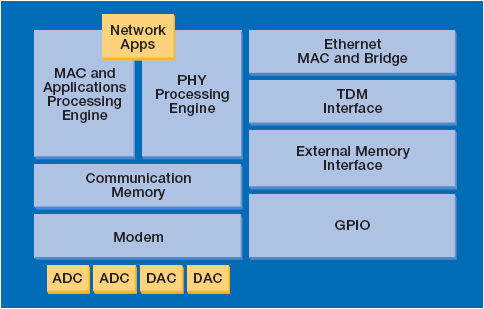
As regards the capabilities of PRO/Wireless 5116 chipset officially presented by Intel in April 2005, it proved to be one of the first products in the industry with support for the WiMAX standard. This Intel chipset is made in a 360-pin PBGA casing, offers functionality needed to implement establish economical high-speed wireless modems for the home and office. Solutions based on PRO/Wireless 5116 allow providing broadband access to the Internet in remote areas where no DSL or cable networks are there and establish communication between tasks distributed a few miles apart.
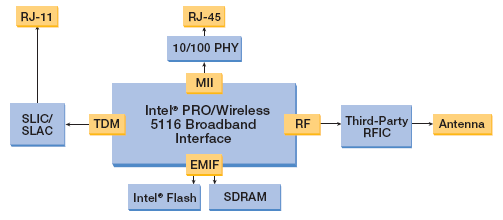
Combined with a RF module and a third-party amplifier, the SoC system Intel PRO/Wireless 5116 with support for IEEE 802.16-2004, formerly known as the Rosedale, provides the possibility to use WiMAX networks for a wide circle of users.. At the same time, the Intel PRO/Wireless 5116 interface supports not only external but internal solutions, e.g. WiMAX subscriber modems and home-based gateways.
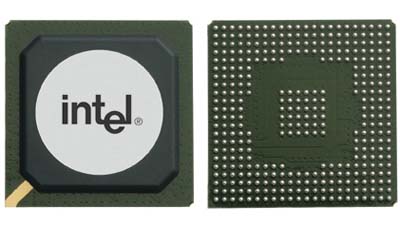
Intel PRO/Wireless 5116 (Rosedale)
WiMAX Forum. Intel's role in establishing the standard
For the purposes of testing, standardization, certification and marketing of WiMAX products, the WiMAX Forum industry alliance has been established. It's just this alliance that issues "WiMAX Forum Certified" verdicts. By now, the number of WiMAX Forum members is rapidly approaching to 200, and over one quarter of the number are operators who are rendering provider services based on the WiMAX technology.
Once of the most active member of the WiMAX Forum alliance is Intel who participates in all the undertakings – from problem statement up to the ratification of standards and development of end equipment. Intel is now cooperating with companies who have deployed pre-standardized WiMAX broadband wireless networks in over than 125 countries. They offer a wide range of options - from stationary systems of wireless access up to enterprise-scale point-to-point data transmission systems.
For the purposes of testing, standardization, certification and marketing of WiMAX products, the WiMAX Forum industry alliance has been established. It's just this alliance that issues "WiMAX Forum Certified" verdicts. By now, the number of WiMAX Forum members is rapidly approaching to 200, and over one quarter of the number are operators who are rendering provider services based on the WiMAX technology. Apart from Intel Corporation, other known companies participate in the WiMAX Forum, among them Airspan Networks, Alvarion, Aperto Networks, Ensemble Communications, Fujitsu Microelectronics America, Nokia, OFDM Forum, Proxim Corporation, Wi-LAN Inc. and others.
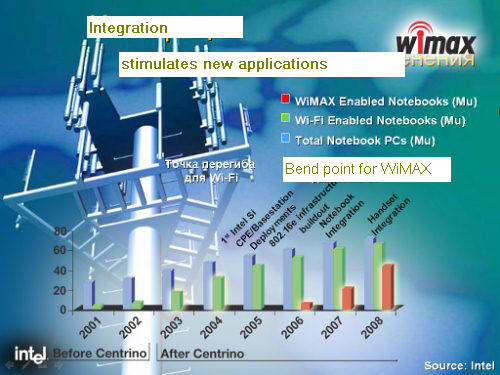
One of the most active member of the WiMAX Forum alliance is Intel who participates in all the undertakings – from problem statement up to the ratification of standards and development of end equipment. Intel is now cooperating with companies who have deployed pre-standardized WiMAX broadband wireless networks in over than 125 countries. They offer a wide range of options - from stationary systems of wireless access up to enterprise-scale point-to-point data transmission systems.

Among the operators collaborating with Intel at the promoting of WiMAX solutions are AT&T (USA), Altitude Telecom (France), BT (U.K.), Brazil Telecom (Brazil), ETB (Columbia), Iberbanda (Spain), Millicom (Argentina), Qwest (USA), Sify (India), Speakeasy (USA), Telkom (South Africa), Telmex (Mexico), TowerStream (USA), and the already mentioned "Ukrainian Advanced Technologies" (Ukraine). The release of produce manufactured on the base of Intel PRO/Wireless 5116 has been announced by Airspan, Alvarion, Aperto Networks, Axxcelera Broadband Wireless, Gemtek, Huawei, Proxim Corporation, Redline Communications, Siemens Mobile, SR Telecom, and ZTE.
Remarkably, these days Motorola and Intel announced their joint plans for promoting the IEEE 802.16e-based WiMAX technology for mobile solutions and which is applicable to both stationary and wireless devices fir broadband communications. Apart from promoting the WiMAX standards, the joint plans of these companies include tests of mobile devices, networked and subscriber end equipment made by Motorola for compatibility to Intel's produce.
WiMAX in Russia
Late in October, the first in Russia seminar on using the WiMAX arranged by Intel was held in Nizhny Novgorod. The seminar gathered representatives, telecommunication companies, providers, developers and manufacturers of wireless communications equipment, as well as government institutions in charge of frequency regulations and licensing. During the event, Intel representatives demonstrated a model of operating network built on the base of the Intel Pro/Wireless 5116 chipset.
Alas - not all are as enthusiastic as Intel. As regards the real dates for introduction of a new backbone wireless standard in Russia, many analysts agree that formation of WiMAX networks in Russia will not start earlier than the summer of 2006. Many pledge to the incomplete certification for WiMAX equipment, many complain about the high price of first-generation WiMAX solutions, but in general there is a lack of intention from the side of providers to spend for a technology which is unlikely to pay back soon. In large cities where there are still more than enough facilities for fast-speed Internet access, the Wi-Fi capacity is still enough. As regards deployment of WiMAX networks somewhere in remote areas in Russia, no one is yet planning to do so at the first stage. Of course, there will be isolated instances of WiMAX network deployment, but we won't hear about them in the near future. But while there is little interest from administrative bodies and lack funding all these events will still be unique.
In a word, many agree that WiMAX networks are unlikely to go beyond the boundaries of large Russian cities earlier than 2009. At the same time, in the Net you can find a variety of contrary opinions stating that if introduction of WiMAX networks at the first stage proves successful, their number may go up as a snowball within short terms.
Perhaps I'd rather stop my today's story at the note of uncertainty. Early in 2006, the WiMAX standard is in for another epochal event and we'll hope that by that time the news on Russian market of WiMAX networks will be more optimistic.
WiMAX today and tomorrow
WiMAX today
Despite the all-round occurrence of the WiMAX still in the design even in the most developed countries, introduction of the standard is progressing at an enviable pace. Quite recently, last autumn during the days of Intel Developers' Forum in the building of Russian Academy of Sciences the experimental network IEEE802.16-2004 was demonstrated in action. And last week in Kiev, Ukraine, Ukrainian advanced technologies commissioned the first in the ex-USSR network of wireless broadband access to Internet on the base of the WiMAX technology. From that week onwards, the network by "Ukrainian Advanced Technologies" dubbed ALTERNET started rendering services of wireless broadband access to Internet on the base of WiMAX using client devices built on the Intel PRO/Wireless 5116 chipset.
The services are about fixed wireless access to Internet using the WiMAX technology based on the Alvarion client equipment built on the Intel PRO/Wireless 5116 chipset. They are offered to companies and private persons who are based in the areas of poorly developed or outdated cable infrastructure. "Ukrainian Advanced Technologies" intends to provide its services on a turn-key basis in merely two days after the first customer's call. Today, you can subscribe to the services in Kiev and Kharkov. There are plans for the first quarter of the next year to establish regional offices to render the access services in Dnepropetrovsk, Odessa, Donetsk, and Lvov. On the whole, it is planned to provide WiMAX connection facilities in all the regional centers of Ukraine by the end of 2006.
In fact, you shouldn't think that some sort of a WiMAX anomaly is going on in the Ukraine. Introduction of WiMAX networks is going on continuously these days, announcements of launching such networks are appearing every day, and only in Russia this issue is being solved extremely slowly (read below).
Modern hardware for WiMAX
As regards the capabilities of PRO/Wireless 5116 chipset officially presented by Intel in April 2005, it proved to be one of the first products in the industry with support for the WiMAX standard. This Intel chipset is made in a 360-pin PBGA casing, offers functionality needed to implement establish economical high-speed wireless modems for the home and office. Solutions based on PRO/Wireless 5116 allow providing broadband access to the Internet in remote areas where no DSL or cable networks are there and establish communication between tasks distributed a few miles apart.
Combined with a RF module and a third-party amplifier, the SoC system Intel PRO/Wireless 5116 with support for IEEE 802.16-2004, formerly known as the Rosedale, provides the possibility to use WiMAX networks for a wide circle of users.. At the same time, the Intel PRO/Wireless 5116 interface supports not only external but internal solutions, e.g. WiMAX subscriber modems and home-based gateways.
Intel PRO/Wireless 5116 (Rosedale)
WiMAX Forum. Intel's role in establishing the standard
For the purposes of testing, standardization, certification and marketing of WiMAX products, the WiMAX Forum industry alliance has been established. It's just this alliance that issues "WiMAX Forum Certified" verdicts. By now, the number of WiMAX Forum members is rapidly approaching to 200, and over one quarter of the number are operators who are rendering provider services based on the WiMAX technology.
Once of the most active member of the WiMAX Forum alliance is Intel who participates in all the undertakings – from problem statement up to the ratification of standards and development of end equipment. Intel is now cooperating with companies who have deployed pre-standardized WiMAX broadband wireless networks in over than 125 countries. They offer a wide range of options - from stationary systems of wireless access up to enterprise-scale point-to-point data transmission systems.
For the purposes of testing, standardization, certification and marketing of WiMAX products, the WiMAX Forum industry alliance has been established. It's just this alliance that issues "WiMAX Forum Certified" verdicts. By now, the number of WiMAX Forum members is rapidly approaching to 200, and over one quarter of the number are operators who are rendering provider services based on the WiMAX technology. Apart from Intel Corporation, other known companies participate in the WiMAX Forum, among them Airspan Networks, Alvarion, Aperto Networks, Ensemble Communications, Fujitsu Microelectronics America, Nokia, OFDM Forum, Proxim Corporation, Wi-LAN Inc. and others.
One of the most active member of the WiMAX Forum alliance is Intel who participates in all the undertakings – from problem statement up to the ratification of standards and development of end equipment. Intel is now cooperating with companies who have deployed pre-standardized WiMAX broadband wireless networks in over than 125 countries. They offer a wide range of options - from stationary systems of wireless access up to enterprise-scale point-to-point data transmission systems.
Among the operators collaborating with Intel at the promoting of WiMAX solutions are AT&T (USA), Altitude Telecom (France), BT (U.K.), Brazil Telecom (Brazil), ETB (Columbia), Iberbanda (Spain), Millicom (Argentina), Qwest (USA), Sify (India), Speakeasy (USA), Telkom (South Africa), Telmex (Mexico), TowerStream (USA), and the already mentioned "Ukrainian Advanced Technologies" (Ukraine). The release of produce manufactured on the base of Intel PRO/Wireless 5116 has been announced by Airspan, Alvarion, Aperto Networks, Axxcelera Broadband Wireless, Gemtek, Huawei, Proxim Corporation, Redline Communications, Siemens Mobile, SR Telecom, and ZTE.
Remarkably, these days Motorola and Intel announced their joint plans for promoting the IEEE 802.16e-based WiMAX technology for mobile solutions and which is applicable to both stationary and wireless devices fir broadband communications. Apart from promoting the WiMAX standards, the joint plans of these companies include tests of mobile devices, networked and subscriber end equipment made by Motorola for compatibility to Intel's produce.
WiMAX in Russia
Late in October, the first in Russia seminar on using the WiMAX arranged by Intel was held in Nizhny Novgorod. The seminar gathered representatives, telecommunication companies, providers, developers and manufacturers of wireless communications equipment, as well as government institutions in charge of frequency regulations and licensing. During the event, Intel representatives demonstrated a model of operating network built on the base of the Intel Pro/Wireless 5116 chipset.
Alas - not all are as enthusiastic as Intel. As regards the real dates for introduction of a new backbone wireless standard in Russia, many analysts agree that formation of WiMAX networks in Russia will not start earlier than the summer of 2006. Many pledge to the incomplete certification for WiMAX equipment, many complain about the high price of first-generation WiMAX solutions, but in general there is a lack of intention from the side of providers to spend for a technology which is unlikely to pay back soon. In large cities where there are still more than enough facilities for fast-speed Internet access, the Wi-Fi capacity is still enough. As regards deployment of WiMAX networks somewhere in remote areas in Russia, no one is yet planning to do so at the first stage. Of course, there will be isolated instances of WiMAX network deployment, but we won't hear about them in the near future. But while there is little interest from administrative bodies and lack funding all these events will still be unique.
In a word, many agree that WiMAX networks are unlikely to go beyond the boundaries of large Russian cities earlier than 2009. At the same time, in the Net you can find a variety of contrary opinions stating that if introduction of WiMAX networks at the first stage proves successful, their number may go up as a snowball within short terms.
Perhaps I'd rather stop my today's story at the note of uncertainty. Early in 2006, the WiMAX standard is in for another epochal event and we'll hope that by that time the news on Russian market of WiMAX networks will be more optimistic.
WiMAX today and tomorrow
WiMAX today
Despite the all-round occurrence of the WiMAX still in the design even in the most developed countries, introduction of the standard is progressing at an enviable pace. Quite recently, last autumn during the days of Intel Developers' Forum in the building of Russian Academy of Sciences the experimental network IEEE802.16-2004 was demonstrated in action. And last week in Kiev, Ukraine, Ukrainian advanced technologies commissioned the first in the ex-USSR network of wireless broadband access to Internet on the base of the WiMAX technology. From that week onwards, the network by "Ukrainian Advanced Technologies" dubbed ALTERNET started rendering services of wireless broadband access to Internet on the base of WiMAX using client devices built on the Intel PRO/Wireless 5116 chipset.
The services are about fixed wireless access to Internet using the WiMAX technology based on the Alvarion client equipment built on the Intel PRO/Wireless 5116 chipset. They are offered to companies and private persons who are based in the areas of poorly developed or outdated cable infrastructure. "Ukrainian Advanced Technologies" intends to provide its services on a turn-key basis in merely two days after the first customer's call. Today, you can subscribe to the services in Kiev and Kharkov. There are plans for the first quarter of the next year to establish regional offices to render the access services in Dnepropetrovsk, Odessa, Donetsk, and Lvov. On the whole, it is planned to provide WiMAX connection facilities in all the regional centers of Ukraine by the end of 2006.
In fact, you shouldn't think that some sort of a WiMAX anomaly is going on in the Ukraine. Introduction of WiMAX networks is going on continuously these days, announcements of launching such networks are appearing every day, and only in Russia this issue is being solved extremely slowly (read below).
Modern hardware for WiMAX
As regards the capabilities of PRO/Wireless 5116 chipset officially presented by Intel in April 2005, it proved to be one of the first products in the industry with support for the WiMAX standard. This Intel chipset is made in a 360-pin PBGA casing, offers functionality needed to implement establish economical high-speed wireless modems for the home and office. Solutions based on PRO/Wireless 5116 allow providing broadband access to the Internet in remote areas where no DSL or cable networks are there and establish communication between tasks distributed a few miles apart.
Combined with a RF module and a third-party amplifier, the SoC system Intel PRO/Wireless 5116 with support for IEEE 802.16-2004, formerly known as the Rosedale, provides the possibility to use WiMAX networks for a wide circle of users.. At the same time, the Intel PRO/Wireless 5116 interface supports not only external but internal solutions, e.g. WiMAX subscriber modems and home-based gateways.
Intel PRO/Wireless 5116 (Rosedale)
WiMAX Forum. Intel's role in establishing the standard
For the purposes of testing, standardization, certification and marketing of WiMAX products, the WiMAX Forum industry alliance has been established. It's just this alliance that issues "WiMAX Forum Certified" verdicts. By now, the number of WiMAX Forum members is rapidly approaching to 200, and over one quarter of the number are operators who are rendering provider services based on the WiMAX technology.
Once of the most active member of the WiMAX Forum alliance is Intel who participates in all the undertakings – from problem statement up to the ratification of standards and development of end equipment. Intel is now cooperating with companies who have deployed pre-standardized WiMAX broadband wireless networks in over than 125 countries. They offer a wide range of options - from stationary systems of wireless access up to enterprise-scale point-to-point data transmission systems.
For the purposes of testing, standardization, certification and marketing of WiMAX products, the WiMAX Forum industry alliance has been established. It's just this alliance that issues "WiMAX Forum Certified" verdicts. By now, the number of WiMAX Forum members is rapidly approaching to 200, and over one quarter of the number are operators who are rendering provider services based on the WiMAX technology. Apart from Intel Corporation, other known companies participate in the WiMAX Forum, among them Airspan Networks, Alvarion, Aperto Networks, Ensemble Communications, Fujitsu Microelectronics America, Nokia, OFDM Forum, Proxim Corporation, Wi-LAN Inc. and others.
One of the most active member of the WiMAX Forum alliance is Intel who participates in all the undertakings – from problem statement up to the ratification of standards and development of end equipment. Intel is now cooperating with companies who have deployed pre-standardized WiMAX broadband wireless networks in over than 125 countries. They offer a wide range of options - from stationary systems of wireless access up to enterprise-scale point-to-point data transmission systems.
Among the operators collaborating with Intel at the promoting of WiMAX solutions are AT&T (USA), Altitude Telecom (France), BT (U.K.), Brazil Telecom (Brazil), ETB (Columbia), Iberbanda (Spain), Millicom (Argentina), Qwest (USA), Sify (India), Speakeasy (USA), Telkom (South Africa), Telmex (Mexico), TowerStream (USA), and the already mentioned "Ukrainian Advanced Technologies" (Ukraine). The release of produce manufactured on the base of Intel PRO/Wireless 5116 has been announced by Airspan, Alvarion, Aperto Networks, Axxcelera Broadband Wireless, Gemtek, Huawei, Proxim Corporation, Redline Communications, Siemens Mobile, SR Telecom, and ZTE.
Remarkably, these days Motorola and Intel announced their joint plans for promoting the IEEE 802.16e-based WiMAX technology for mobile solutions and which is applicable to both stationary and wireless devices fir broadband communications. Apart from promoting the WiMAX standards, the joint plans of these companies include tests of mobile devices, networked and subscriber end equipment made by Motorola for compatibility to Intel's produce.
WiMAX in Russia
Late in October, the first in Russia seminar on using the WiMAX arranged by Intel was held in Nizhny Novgorod. The seminar gathered representatives, telecommunication companies, providers, developers and manufacturers of wireless communications equipment, as well as government institutions in charge of frequency regulations and licensing. During the event, Intel representatives demonstrated a model of operating network built on the base of the Intel Pro/Wireless 5116 chipset.
Alas - not all are as enthusiastic as Intel. As regards the real dates for introduction of a new backbone wireless standard in Russia, many analysts agree that formation of WiMAX networks in Russia will not start earlier than the summer of 2006. Many pledge to the incomplete certification for WiMAX equipment, many complain about the high price of first-generation WiMAX solutions, but in general there is a lack of intention from the side of providers to spend for a technology which is unlikely to pay back soon. In large cities where there are still more than enough facilities for fast-speed Internet access, the Wi-Fi capacity is still enough. As regards deployment of WiMAX networks somewhere in remote areas in Russia, no one is yet planning to do so at the first stage. Of course, there will be isolated instances of WiMAX network deployment, but we won't hear about them in the near future. But while there is little interest from administrative bodies and lack funding all these events will still be unique.
In a word, many agree that WiMAX networks are unlikely to go beyond the boundaries of large Russian cities earlier than 2009. At the same time, in the Net you can find a variety of contrary opinions stating that if introduction of WiMAX networks at the first stage proves successful, their number may go up as a snowball within short terms.
Perhaps I'd rather stop my today's story at the note of uncertainty. Early in 2006, the WiMAX standard is in for another epochal event and we'll hope that by that time the news on Russian market of WiMAX networks will be more optimistic.
WiMAX: wireless highway to the future
By: Vladimir Romanchenko
Evolution of WiMAX
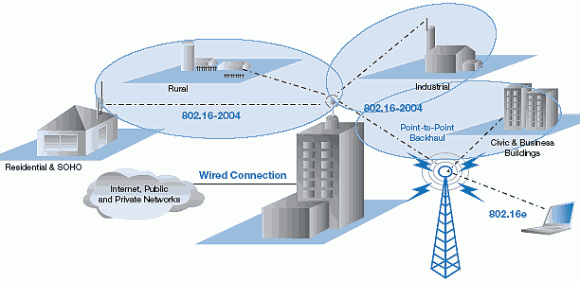
At first, there was the cable. No, that's wrong. First, there was the word, of course, and then the deed which resulted later in computers and other electronics - from super-clusters to mobiles. Then there rose the need for interaction among all this electronics. This is the way how the cable came into being, that is, first hard-wire interfaces. Then wireless, as technologies progressed. Leaving this long and sometimes heroic past of hard-wire networks outside the note, let's move on to the most interesting part - the current situation and the nearest future wireless prospects.
Separate Wi-Fi access points that could be plugged in to powerful backbone "hard-wire" networks, e.g. fiber-optical, were the first timid moves towards creation of wireless networks. Then there came up a new class of providers who deployed numerous commercial networks, thus in a matter of few years Wi-Fi networks turned into serious infrastructures - corporate and public. By now, many hotels, airports, and railway stations of the world have acquired Wi-Fi networks, and in some countries residential communities are covered this way.
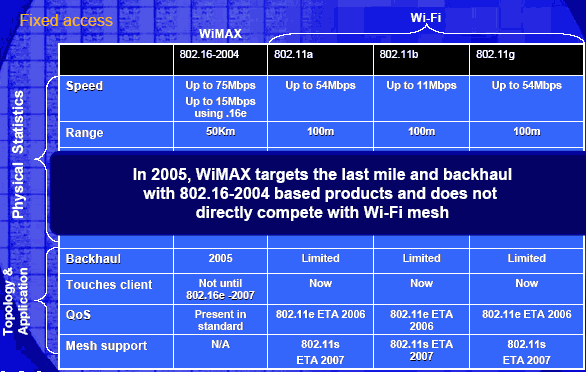
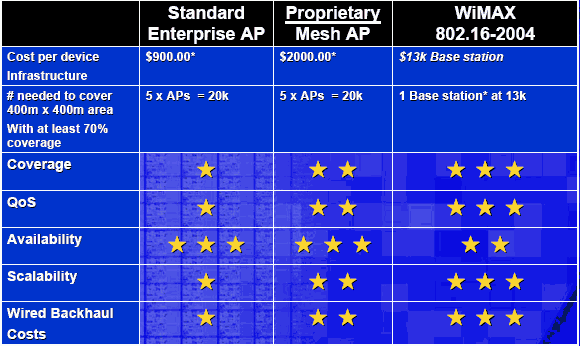
No doubt, introduction of Wi-Fi wireless networks has proved a revolutionary solution to the "last mile" problem. However, the standard's original limitations for data exchange rate and range, number of channels, high cost of the infrastructure have not yet made it possible for Wi-Fi to become a total threat to cellular networks on the one hand, and hard-wire networks, on the other. Even despite the substantial advantages and introduction of new, more up-to-date versions of the standard, the "native limitations" of Wi-Fi will be eliminated only through new backbone standards for data exchange. Sort of WiMAX.
WiMAX Definition
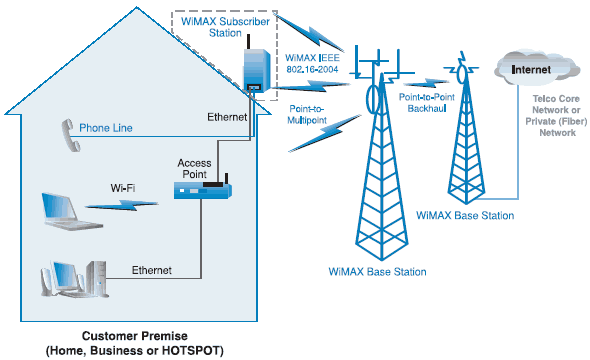
WiMAX stands for Worldwide Interoperability for Microwave Access, and is a technology of broadband wireless communication standardized by the IEEE which complements DSL lines and cable technologies as an alternative solution to the "last mile" problem at great distances. The WiMAX technology can be used to implement broadband "last mile" connections, deployment of wireless access point, arrangement of high-speed communication among company branches and solution of other similar tasks.
Evolution of WiMAX
The preliminary version of WiMAX provided functionality with the equipment which was not subject to standard tests for compatibility to the WiMAX technology. A number of service providers are still using such preliminary hardware solutions to implement WiMAX pilot projects in many parts of the world. Once tests for compatibility of these systems to the WiMAX technology are complete, they will most likely be upgraded programmatically in compliance with the requirements of the final WiMAX standard.
In ideal, the wireless technology WiMAX based on industrial standards is developed to provide inexpensive high-speed communication for residential areas, enterprises, and mobile networks in cities and in rural areas. Note the definition - it contains a "niche" for the interaction of backbone WiMAX with the "local" Wi-Fi.
Outlooks for WiMAX in the nearest future
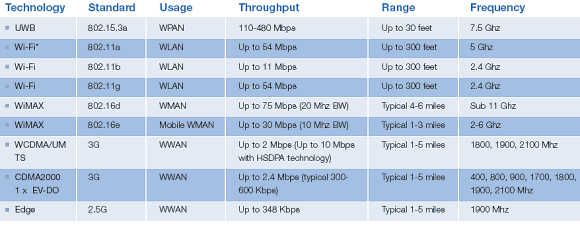
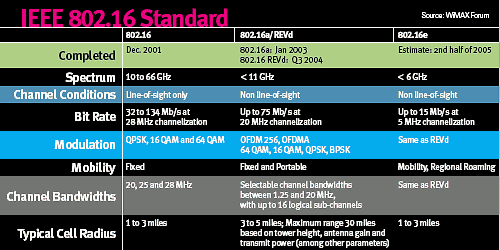
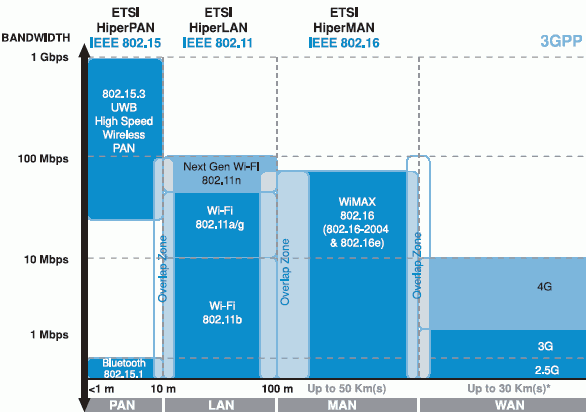
Today's WiMAX in the version IEEE 802.16-2004 is a standard of wireless communication, which provides broadband communication in the area of over 30 km in range with the bandwidth comparable to that for cable bonds - up to 10 Mbit/s and higher. The WiMAX technology allows operating in any conditions, including in the dense urban coverage, and providing a high quality of communications and data transmission rate.
The equipment of WiMAX networks operates in several frequency channels of 10 MHz width within the range from 2 GHz to 11 GHz. Certainly, the specific distribution of frequency ranges in various countries calls for the need to operate WiMAX in various sectors. Such a wide discrepancy of ranges has been selected to cover the specifics of most countries of the world. For instance, in the North America the WiMAX uses sectors in the 2.5 and 5 GHz ranges, in the Central and South America - 2.5, 3.5, and 5 GHz, in the Middle East , Africa, Western and Eastern Europe - 3.5 and 5 GHz, in the Asian Pacific region - 2.3, 3.5, and 5 GHz.
Essentially, WiMAX is a technology that provides access to Internet at T1 speed with the performance and coverage much higher than in modern Wi-Fi networks. In its turn, local Wi-Fi networks, various types of business and household cable/DSL networks of end users are just the continuation of WiMAX "backbone branches".
Establishing communications within 10 km range and farther, WiMAX points provide coverage of vast areas thus giving providers flexible enough conditions to ensure the very "last mile communication".
On the whole, the base characteristic of 802.16 standard provide a reach as far as 50 km, and coverage with the possible operation outside the direct visibility zone, which in prospect will give a peak data exchange rate up to 70 Mbit/s per sector, with the typical base station having up to coverage sectors.
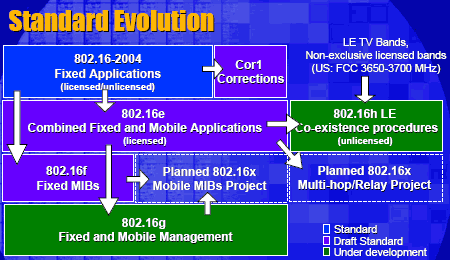
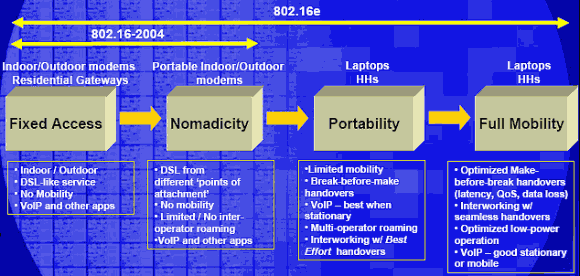
Today, introduction of WiMAX is subdivided into the three main stages. The current first stage implies introduction and wide distribution of the WiMAX technology of EEE 802.16-2004 standard which came to replace the earlier versions IEEE 802.16a and 802.16d, and which uses external aerials of the "cellular disc" type aimed at consumers in fixed directions.
The second stage implies use of internal aerials, simplified and more flexible use of WiMAX to provide access.
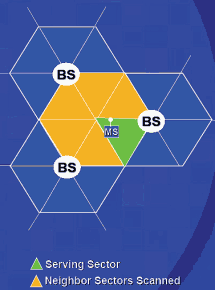
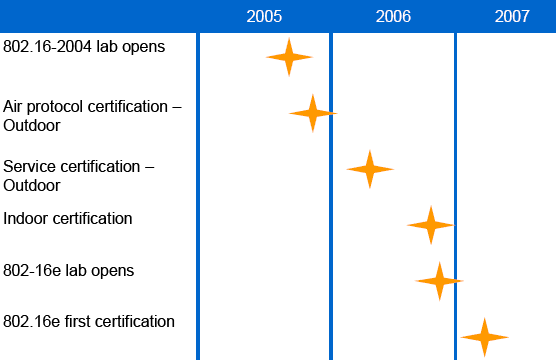
The third stage promises a wide introduction of IEEE 802.16e specifications whose ratification is expected in early 2006, and the emergence of first networks expected in 2007. That means the possibility for operating WiMAX-Certified solutions even as part of portable devices moving across the certain "coverage area" of the network, in the image and likeness of modern cellular and Wi-Fi networks.
Development of such complex standards implies co-existence with other wireless standards, including cellular networks, development of new generations of "smart" aerials, application of new type of modulation like OFDMA, new types of services like QoS, data protection, and many other parameters. In this WiMAX review, we are not giving a detailed account of all the fine points of new standards, but in fact it is a long and painstaking process.
As regards the capabilities of the first-generation WiMAX - IEEE 802.16-2004, in ideal, each base station provides coverage within the range of up to 50 km at data exchange rate up to 35 Mbit/s. In practice, the width and respective performance of the channel is "sliced" for the end user by the service provider. But the way, the architecture of WiMAX networks which in ideal resembles honeycombs (but of a much larger "cell") implies placing antenna-feeder devices on high buildings, structures, and masts. No wonder that interest to the deployment of WiMAX networks was shown primarily by cellular network providers: however strong the competition between WiMAX and 3G/4G networks is, it is much cheaper to install and service several types of equipment on the same mast rather than on several ones. In any case, it is up to the consumer to decide whether to give preference to a specific network.
Today, maximum attention to the introduction of WiMAX networks is paid in the countries of vast territories and great distances from cities, as well as high percentage of rural population. Even for the most developed countries like Sweden it is of advantage to introduce WiMAX as an alternative to hard-wire backbone communications, GSM/EDGE and 3G networks. Needless to say, developing countries like China, India, and Russia will have to start from scratch.
Subscribe to:
Posts (Atom)